


By Cindy Gonzalez | Nebraska Examiner

LINCOLN — Despite a recent kerfuffle over alleged flaws in Nebraska’s business incentives, a new tax incentives package aimed at keeping and attracting high-paying jobs drew no resistance Wednesday during a legislative hearing.
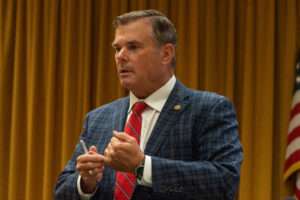
Eleven speakers largely representing Chambers of Commerce and cities testified in favor of Legislative Bill 1165, introduced by Omaha State Sen. Brad von Gillern on behalf of Gov. Jim Pillen.
No one spoke in opposition of the so-called “Grow the Good Life Act,” which modifies three existing incentives laws and adds a new grant program.
While the proposed legislation never mentions Union Pacific Railroad, von Gillern told the Legislature’s Revenue Committee it’s no secret that key perks of LB 1165 aim to keep the Fortune 500 company’s headquarters in Omaha and workforce growth in the Cornhusker State as a merger progresses with Georgia-based Norfolk Southern Railroad.
If federal officials approve the union, the combined workforce would reach about 50,000 employees across 43 states. Just five years ago, Northern Southern opened a modern headquarters in Atlanta that’s home to more than 3,000 of its workers. More than 5,500 of Union Pacific’s workers live in Nebraska.
‘Pay-for-performance’
Anticipating critics, von Gillern called his priority bill a “pay-for-performance” measure that contains clawbacks. He said it was “not about corporate welfare, as some will try to say.”
“What would the fallout of those folks leaving look like?” von Gillern asked, citing what he called “painful” corporate relocations or reorganizations over the last decade including Conagra in Omaha, Cabela’s in Sidney, and the more recent closure of the 3,200-employee Tyson Foods plant in Lexington.
Said von Gillern: “We can’t afford to sit around and wait for the next headline that reads: Company X let 2,000 people go or Company Y reorganized and 3,000 jobs left the state.”
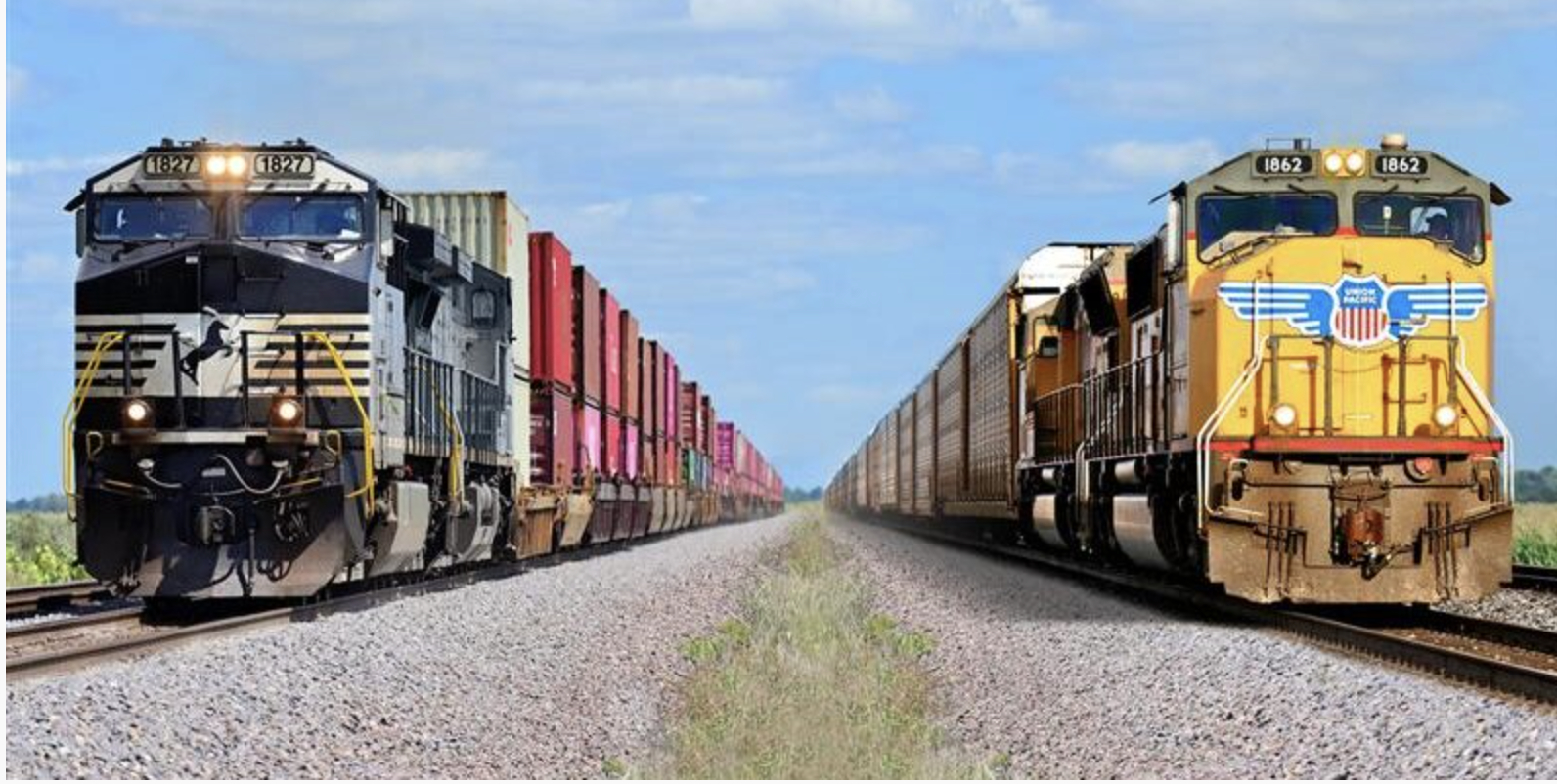
A Union Pacific senior vice president, Josh Perkes, appeared in support of the corporate tax incentives bill.
“We intend for Omaha to remain the company’s headquarters,” Perkes said, though von Gillern quipped earlier that he’d wager Georgia Gov. Brian Kemp already has paid a visit to U.P. with a “checkbook in his pocket.”
Perkes said U.P. contributes to Nebraska communities through an annual payroll of over $800 million and in the past five years invested over $1.5 billion in Nebraska infrastructure. He said LB 1165 would enhance the state’s competitive edge.
What would the fallout of those folks leaving look like?
– State Sen. Brad von Gillern, chair of the Legislature's Revenue Committee
“With hundreds of jobs paying over $100,000 relocating to the state — if our merger is approved — the economic impact on Nebraska will be realized in the near and long term,” Perkes said. He said relocated employees could bring to the state new families, homebuyers, shoppers and diners.
According to a fiscal analysis, the Nebraska Department of Revenue estimates the proposal would create an $8.7 million loss to the state’s general fund in 2026-27 and a $4.58 million loss the following year. Von Gillern said he expects those estimates to change with recent modifications.
Parts of LB 1165 only apply to big companies undergoing a merger. Among highlights:
- Expands the cap for eligible employers on wage credits available under the “Key Employer and Jobs Retention Act” from $4 million to $5 million per year starting in 2030.
- Increases tax credits available under the “ImagiNE Nebraska Act” for wages paid to new employees by one percentage point if the average wage is at least $150% of the statewide average.
- Increases the investment credit for eligible manufacturing projects by one percentage point if investment surpasses a certain amount.
- Increases allowable wage and investment credits by one percentage point to applicants that have 3,000-plus Nebraska employees and within seven years of a merger add another 1,000 employees with salaries of at least $90,000.
- Transfers $5 million transfer from the state’s general fund to support site and building development grants to employers for projects, following a change of ownership, that relate to employee retention and recruitment.
- Creates a grant, not to exceed $300,000 a year per employer undergoing an ownership change, if used to support retention and recruitment of employees during the transition.
Under pressure
LB 1165 responds to pressure from Nebraska business leaders who have been releasing studies showing the state falling behind peers in job growth and economic development and urging more tax incentives to be competitive with other states.
It comes also in the wake of a report from Nebraska State Auditor Mike Foley that pointed out shortfalls in state business incentive programs. The findings by Foley’s audit team were met with criticism from state chamber leaders and von Gillern who said Foley and his team neglected to look at the broader benefits of incentives.
Foley, in his Feb. 13 letter to the Department of Revenue, called out “serious unintended consequences” of two tax incentive programs: the 2005 Nebraska Advantage Act and its 2021 successor, the ImagiNE Nebraska Act.
He called for more scrutiny from Revenue Department officials and lawmakers, saying a result was nearly $1.2 billion in “lost revenue” over the past four fiscal years.
Among issues Foley found “most striking” was the ability of participating companies to “uninvest” in Nebraska but continue to receive incentive payments. He said that because tax filings are confidential, the identities of suspect companies could not be publicly disclosed.
But he described one business whose qualifying project was acquired by another. After closing the project site in Nebraska and eliminating those jobs here, the acquiring company continued to receive millions of dollars in tax incentive refunds, Foley said.

Another business declared bankruptcy and eliminated its qualifying projects over a period of years, Foley said. “Since then, the state has paid the bankruptcy estate millions of dollars in refunds under the Act,” he said.
Said Foley in a media release: “It’s almost as if we are begging companies to take unfair advantage of us.”
In an earlier 2025 letter to the Legislature, Foley said that when carried out properly, tax incentive programs are practical tools for growing Nebraska’s economy and can support an expanding tax base that makes better public services possible. In that review, he noted that apparent “operational inadequacies” in state tax incentive programs can become an economic “drain” as opposed to a “boon.”
Heath Mello, president and CEO of the Greater Omaha Chamber and former state lawmaker, quickly responded to the more recent Revenue Department letter. He said in a statement that the chamber “strongly” disagreed with the auditor’s “one-sided assessment on business incentives.”
Mello also spoke Wednesday in favor of LB 1165.
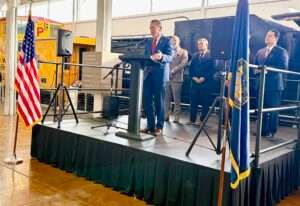
Von Gillern said he found Foley’s comments “unnecessarily inflammatory.” He pointed to findings of an interim study last year by the Legislature’s Revenue Committee on tax incentive programs, which said the Advantage Act had generated $27.3 billion in investment and created more than 33,000 jobs since 2005. The report described that as nearly 10 times the state’s return on investment.
Of the newer ImagiNE Nebraska program, the report said that as of last June, 112 signed agreements projected 3,719 new jobs and $4.3 billion in investment. Two years of qualified activity reflected $32.2 million tax credits earned, with $5.2 million being used, leaving $27 million in outstanding credits.
“Overall, Nebraska’s incentive programs have generated substantial private investment and employment relative to their fiscal cost,” the report said.
Upside down budget
At Wednesday’s hearing, von Gillern addressed the state’s $471 million projected deficit, anticipating the question: “Isn’t it hard to do this at a time when we’re upside down in our state budget?”
Himself a businessman, he echoed chamber leaders who said they expect the long-term payoff to outshine any cost.

“We don’t want to die as a state,” von Gillern said. “We don’t want to just slow the decline and head into the certain demise of the state by not investing in the future.”
Several speakers said they see the bill benefiting economic development beyond U.P.
State Sen. Mike Jacobson of North Platte, a member of the Revenue Committee, said he believes job growth in the state’s biggest cities will raise tax revenues that could help the state as a whole.
“A rising tide does lift all boats,” he said.
Von Gillern said the committee received written submissions from six proponents and two opponents. The committee took no immediate action on the bill.