


By Allison Peck
Listen to the full interview on our Kubota Podcast
An Ogallala man traveling in Mexico to celebrate his grandmother’s 103rd birthday is now stuck under shelter-in-place conditions as cartel-related violence and widespread road blockades disrupt daily life and travel across parts of the country.
Joey Isenbart arrived in Mexico Thursday, flying into Guadalajara before traveling with family to his grandmother’s home about three hours away. What began as a routine family trip shifted dramatically over the weekend. Joey said that Saturday night, after a birthday celebration, he and his family saw vehicles on fire along the road — something he’d seen before on previous trips and didn’t think twice about.
But by Sunday morning, everything had changed. Joey said his cousin knocked on the door and told them, “You guys ain’t going nowhere. They just killed the big cartel guy. Roads are blocked off. They’re blowing up cars that block the roads off.”
The violence that followed commemorates one of the most significant developments in Mexico’s ongoing drug war: the killing of Nemesio Rubén Oseguera Cervantes — widely known as “El Mencho” — leader of the powerful Jalisco New Generation Cartel (CJNG). El Mencho, considered one of Mexico’s most wanted criminals and a major figure in international drug trafficking, was killed in a military operation by Mexican forces on Feb. 22, according to government statements. He headed one of the country’s most violent and expansive criminal organizations, implicated in trafficking fentanyl, methamphetamine and cocaine, as well as extortion, fuel theft, and other rackets.
The Mexican government reported that his death sparked immediate retaliatory violence across multiple states. Roads were blocked with burning vehicles, fires broke out, and clashes between cartel members and security forces erupted in at least 20 of Mexico’s 31 states. The unrest has led authorities, including the U.S. Embassy, to advise shelter-in-place guidance for U.S. citizens in affected areas due to “ongoing security operations and related criminal activity.”
For Joey and his family, the shift from celebration to crisis was stark. “We woke up yesterday to check in for our flight to leave this morning,” he said. “My cousin’s knocking on the door saying, ‘You ain’t going nowhere.’” He described a town that went eerily quiet as people fled the streets and shops shut their doors. “I’ve been coming here for 30 some years every year and I have never heard flies or mosquitoes. I heard them all day yesterday. This town was dead.”
Local authorities later drove through town with sirens and loudspeakers urging residents to remain indoors for safety. Within hours, family members received mass text alerts reinforcing shelter-in-place orders and instructions for American citizens to contact the U.S. Embassy. Joey said cell service has been “hit and miss” in recent days, complicating contact with loved ones back home.
Joey and his family attempted to leave early Monday for a scheduled 8 a.m. flight from Guadalajara, setting out around midnight. But about an hour from town, at the border between Michoacán and Jalisco, they encountered burning semitrailers blocking the highway. “It was blocked off by semis on fire… and no, you’re not passing,” Joey said. As they turned back, he said they heard gunshots in the distance.
Although Guadalajara’s airport remains operational and flights continue to be scheduled and canceled, Joey said the challenge is reaching it safely. “That’s the problem — getting there,” he said.
Joey emphasized that his experience staying with family in a smaller community is different from what many resort visitors are seeing in major coastal tourist areas. While some flights have been canceled or diverted in places like Puerto Vallarta, the situation for locals — especially outside resort districts — reflects deeper concern. Many residents have been told by family members familiar with the area to stay cautious, avoid going out alone, and avoid identifying themselves as Americans in public.
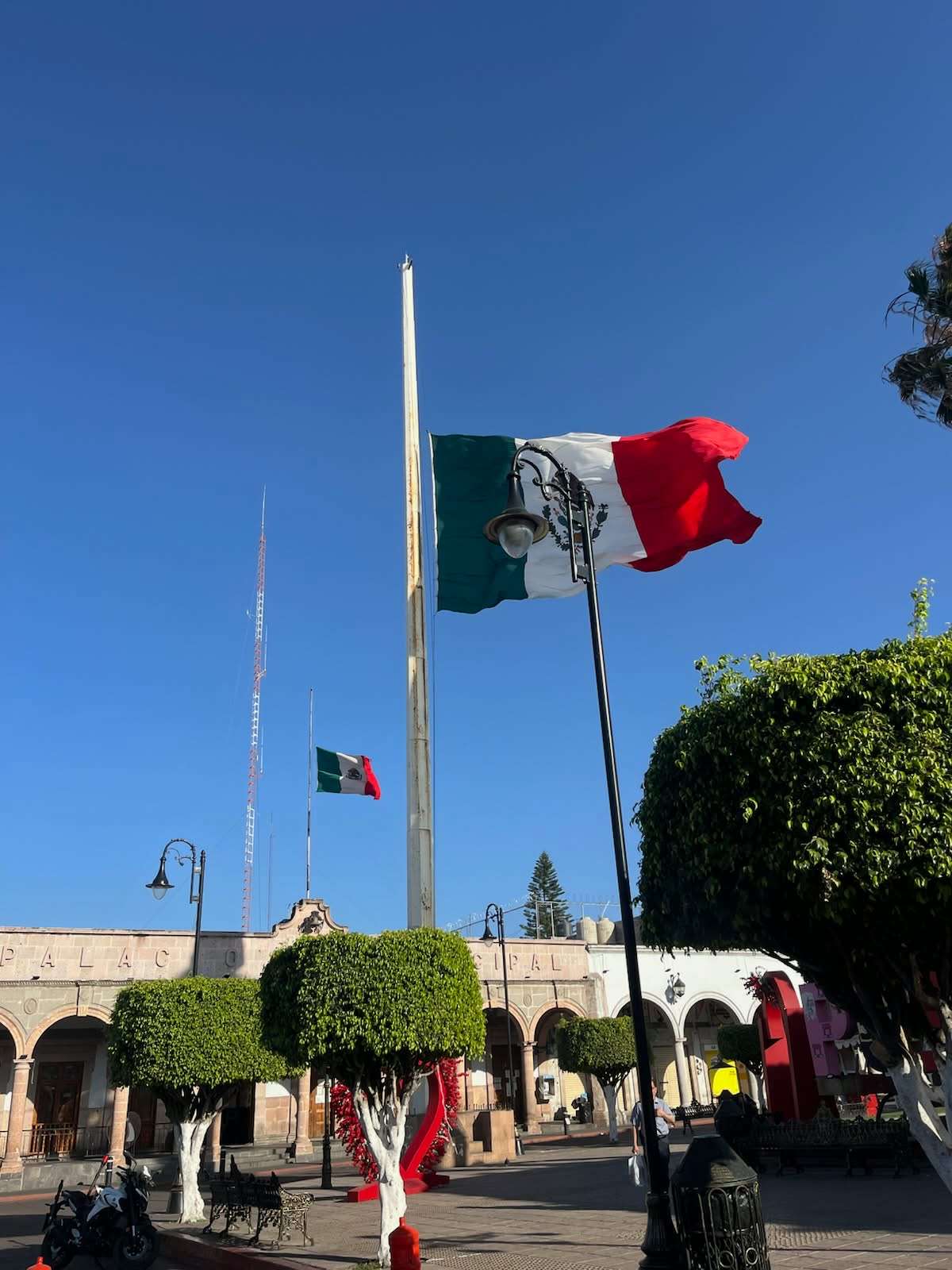
Locals have also interpreted symbolic signs of the unrest in ways that underscore their fear: Joey shared that in his town, people believe the half-mast flag hung over the central plaza was placed there by cartels as a message that, “he might be dead, but we’re still here.” While it cannot be independently verified, that interpretation reflects how deeply cartel influence is perceived among residents.
For Joey personally, the experience has been surreal and sobering. He said although he feels relatively safe staying within town limits, his family is on edge. “If you go out in the country, that’s where the most risk would be,” he said. “If you stay here in town, we’re safe for the most part.”
Officials and analysts warn that the death of a powerful cartel leader like El Mencho can create violent power vacuums as rival factions fight for control, leading to unpredictable and extended periods of unrest. That dynamic helps explain the scale and intensity of the road blockades, fires, and clashes unfolding across the region.
As of now, Joey and his family plan to wait a few more days to see whether roads reopen and travel routes become safer before attempting another departure. “Our main concern right now is can we even get to the airport?” he said.
In the meantime, he urges other Americans in Mexico to follow guidance from the U.S. Embassy and stay in contact with authorities. “Listen to what the embassy says — that’s a big deal for your safety,” he said.